
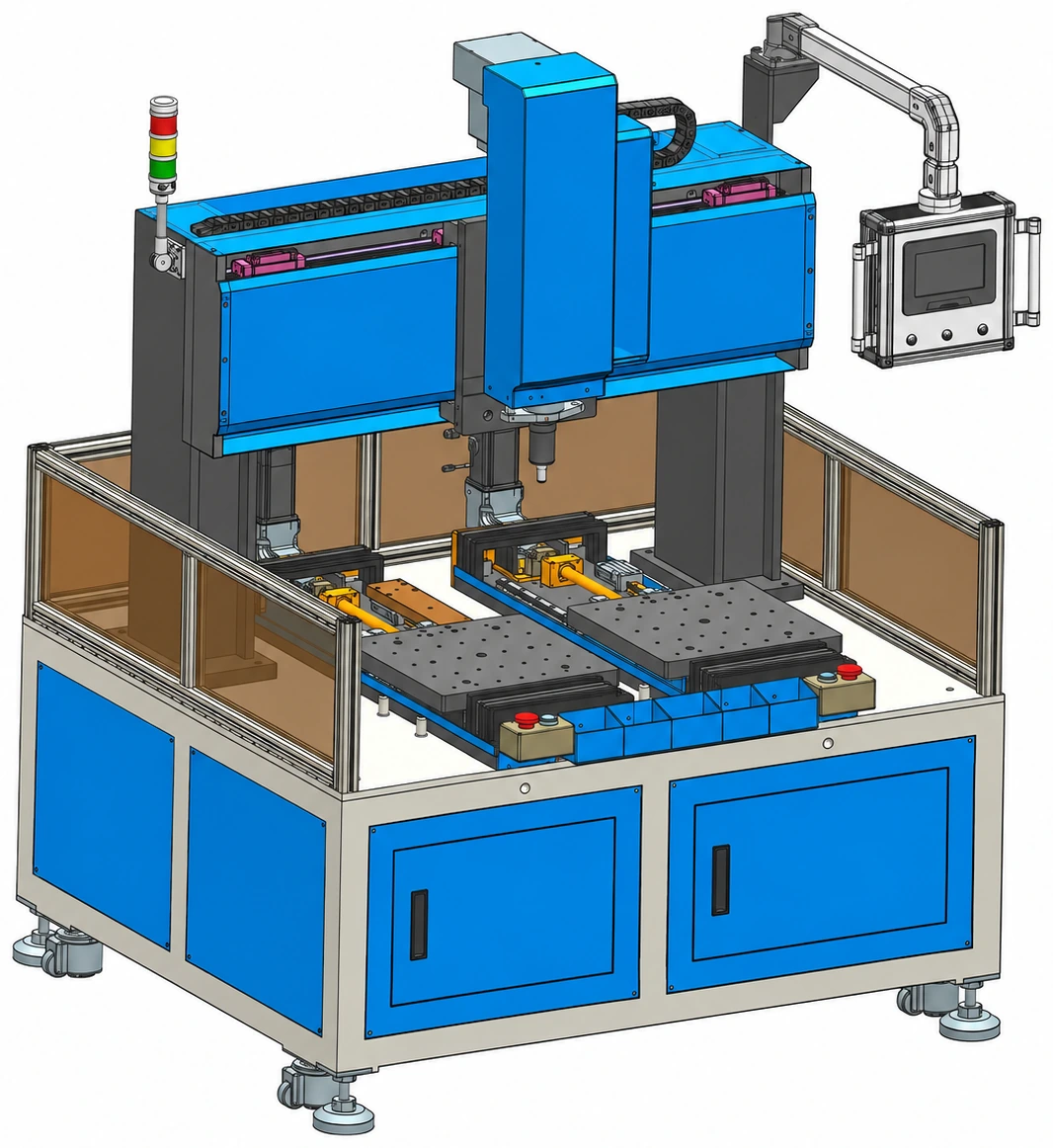
How Dual Tables Coordinate with Servo Riveting
Workpieces are positioned on independent left and right CNC tables, entering the riveting cycle under verified motion recipes. The dual-station layout allows simultaneous loading/unloading while the opposite station is undergoing riveting, substantially raising line throughput.
Conditions for Alternating Operation
Continuous alternate operation requires clear safety zoning, light curtains, interlock logic, and stroke confirmation. Tooling height, fixture clearance, and operator hand clearance are evaluated during technical sign-off to ensure maximum safety and repeatability.
Sample Trials and Acceptance Testing
We recommend providing rivet materials, dimensions, head contours, and target joint strength. Initial sample trials establish the optimal peen profile, rotational speed, stroke depth, and forming quality standards before line build.
Technical Specifications Checklist
- Rivet diameter range: Ø0.5 – Ø12 mm (orbital peen tilt 5° ±0.1°)
- X / Y / Z travel: ≥800 / ≥300 / ≥100 mm with precision servo drives
- Keyence PLC control, touchscreen HMI, and precision load monitoring
- Custom fixtures, sensor interlocks, and automated part presence checks
Request a Technical Feasibility Review
Share your rivet specifications and target cycle time. Our engineering team will review your application and recommend suitable tooling and forming recipes.